
Summary
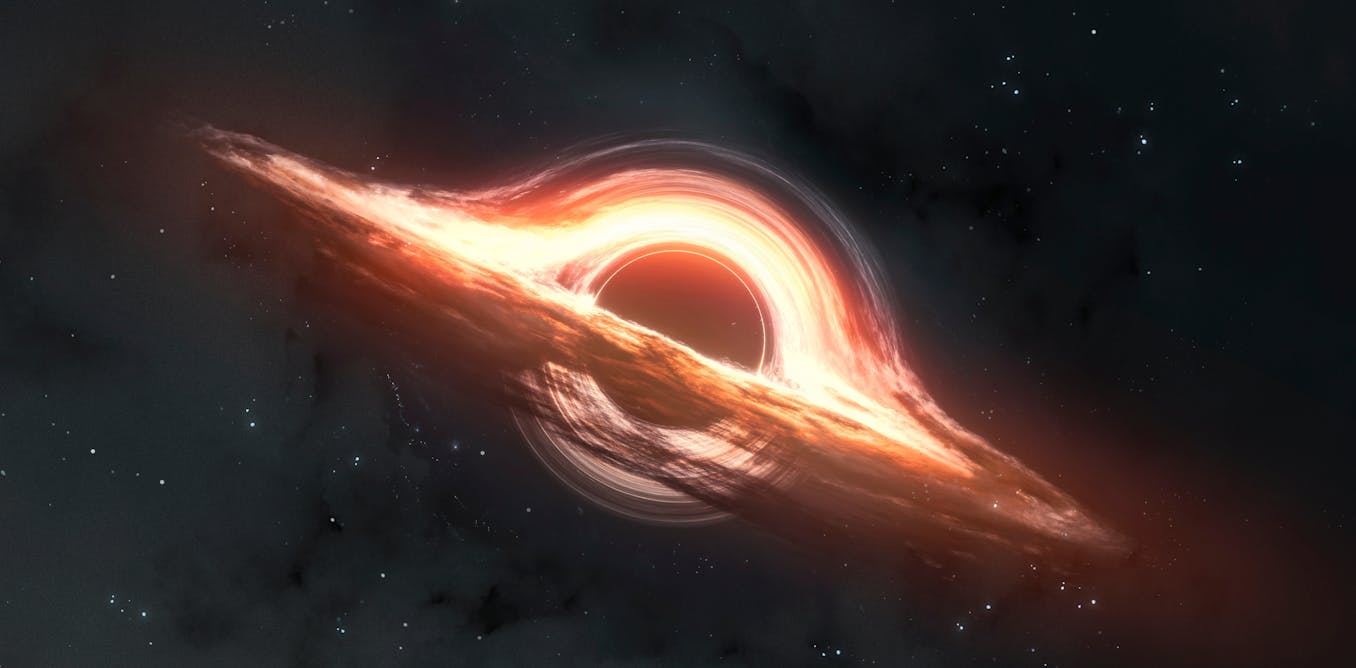
The **Big Bang theory** has long been the cornerstone of our understanding of the universe's origins. However, a new study published by researchers suggests that the universe may have originated from a **black hole**. This idea challenges the traditional view of the Big Bang as the singular moment of creation. The researchers propose that our universe could be a **multiverse**, with multiple universes existing within a larger cosmic structure. This concept is supported by some models of **cosmology** and **theoretical physics**, including the work of **Stephen Hawking** and **Alan Guth**. The implications of this theory are far-reaching, with potential connections to **dark matter** and **dark energy**. For more information, see [[cosmology|Cosmology]] and [[theoretical-physics|Theoretical Physics]].
Key Takeaways
- The universe may have originated from a black hole
- The theory is still highly speculative and requires further testing and validation
- The implications of the theory are far-reaching, with potential connections to dark matter and dark energy
- The scientific community should approach this idea with a critical and open-minded perspective
- Further research is needed to determine the validity and implications of the theory
Balanced Perspective
The proposal that the universe originated from a black hole is an intriguing idea that warrants further investigation. While the mathematical models and simulations are promising, the theory is still highly speculative and requires rigorous testing and validation. It is essential to consider alternative explanations and to evaluate the theory's predictions against observational evidence. The **scientific community** should approach this idea with a critical and open-minded perspective, recognizing both its potential and its limitations. For example, **NASA** and the **European Space Agency** have conducted extensive research on the universe's origins and evolution. See [[nasa|NASA]] and [[european-space-agency|European Space Agency]] for more information.
Optimistic View
The idea that the universe originated from a black hole is a groundbreaking concept that could revolutionize our understanding of **cosmology** and **theoretical physics**. This theory has the potential to resolve long-standing puzzles, such as the **information paradox** and the **hierarchy problem**. Furthermore, it could provide new insights into the nature of **dark matter** and **dark energy**, which are essential for understanding the universe's evolution and structure. As noted by **physicist Brian Greene**, this theory could be a major step forward in our understanding of the universe. See [[brian-greene|Brian Greene]] for more information.
Critical View
The idea that the universe originated from a black hole is a speculative and untested theory that lacks concrete evidence. The mathematical models and simulations are based on simplifying assumptions and may not accurately capture the complexity of the universe. Furthermore, the theory raises more questions than it answers, such as the origin of the black hole itself and the nature of the **multiverse**. It is essential to exercise caution and skepticism when evaluating this theory, recognizing that it may be a **scientific dead end**. As noted by **physicist Lawrence Krauss**, this theory may be an example of **unfalsifiable** science. See [[lawrence-krauss|Lawrence Krauss]] for more information.
Source
Originally reported by The Conversation